

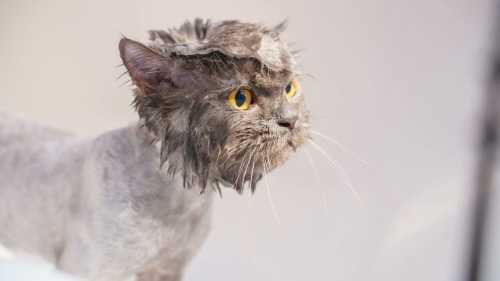
Scrolling through your feed – and there’s a Maine Coon catching a rubber duck from a tub full of foam. In the comments, people share similar experiences:
"Mine loves to catch the stream of water in the shower" or "He jumps into an empty bathtub himself and sits there."
Pure tears of tenderness.
Then you try to do the same with your cat. But the finale is usually different. Torn hands, a cat’s fright, and a wet puddle in your sneakers the next morning.
"He’s getting revenge, the rascal," is the first thought.
And you’re not alone. I often hear from acquaintances, cat owners:
"After washing, the cat sat under the bed for three days and ignored me," or even worse – "He went to the toilet right on important documents and electronics!"
But let’s dismiss unfounded fears. Your cat doesn’t know how to take revenge at all.
The Theory of Cat Conspiracy
To plan cold revenge, episodic memory and a developed prefrontal cortex of the brain are needed. It’s humans who can lie down before sleep, stare at the ceiling, and get worked up.
"Last Tuesday, this biped shoved me into a basin. I will never forgive him for this."
Cats’ brains don’t have our sequential memory, but they do have associative memory. They remember not the plot, but the connection between an event and a threat to life.
Take, for example, a person who touched a hot iron. They don’t start planning revenge on household appliances. It’s just at the reflex level that it’s recorded: this thing is dangerous, stay away.
When you drag a cat into the bathroom, it doesn’t think you’re a bad person. Its amygdala remembers the circumstances. The sound of water + slippery tiles + the chemical smell of shampoo = mortal danger.
A friend once told me:
"After the first unsuccessful bath, my cat has been panicking at even the open bathroom door for ten years."
Then why did the sneakers suffer?
If it’s not revenge, then why did the footwear suffer? – Evolution.
When a cat experiences wild stress, its world collapses. There is no safety. What does a predator do when the ground is pulled out from under its paws and it needs to regain control of its territory somehow? It tries to surround itself with its own, strongest scent.
Your sneakers, a spread-out bed, or a towel left on the floor – this is your smell. And the cat, leaving its “mark” there, seems to say:
"It was very scary here. I need to mix our scents to feel like I’m home again."
The animal is not trying to show aggression; on the contrary, it is begging for help.
By the way, if such behavior has occurred at least once, it makes sense to consult a veterinarian. Severe stress often causes physical ailments. A puddle outside the litter box may not only be an attempt to calm down but also a sign of physical pain.
Little Aliens
If you come across a video of a cat diver on the internet again – remember genetics and habits. Some owners say their cats are not afraid of water because they were trained from a young age (for example, they were picked up from the street and warmed in a warm basin).
The love of water is genetically ingrained in Bengals or Turkish Vans. But all these are more likely exceptions.
If the article was useful, you can share it with friends
Share
⚡ Reader Pulse
Is your cat a cunning avenger or just a scared furball?
1 person has already voted. Join the discussion.
👇 Click on one of the options below
😿 Victim of Circumstances 👿 Cunning Strategist 🧐 I Have My Own Theory
☝️ First, choose your position
✏️ Write a comment
📊 Mind Map
😿 Victim of Circumstances 100% 👿 Cunning Strategist 0% 🧐 I Have My Own Theory 0% 💡
The discussion is just beginning. Be the first to express your opinion!
Comments
Newest First ↕
There are no comments yet. Be the first!